Windows explained
Bay window calculator and survey
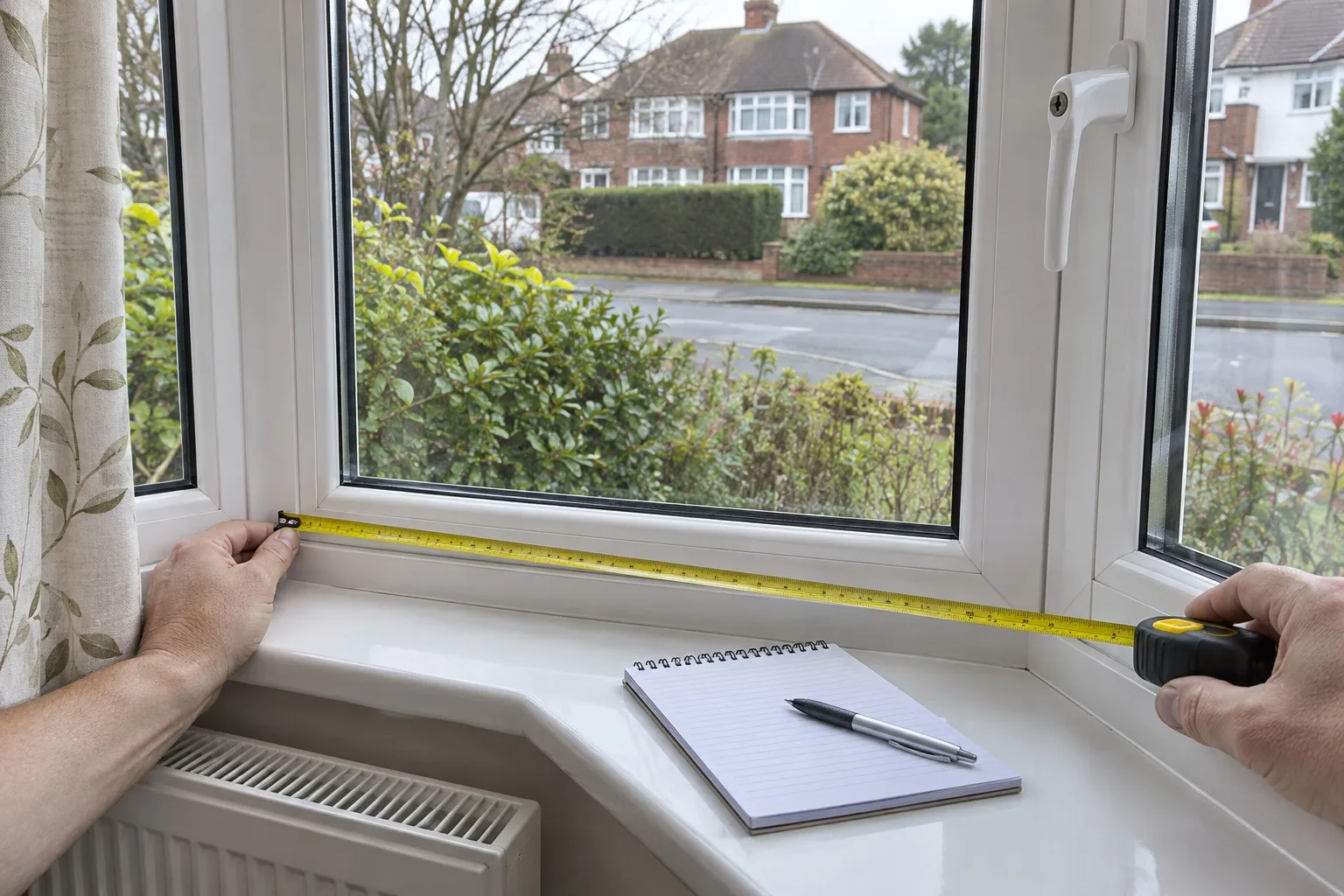
A bay window calculator does one job: it turns the measurements you take inside a bay into the width of each angled window and the angle it sits at. This page has one, and it explains the survey method a fitter uses to prove a bay before the windows are made.
Bay window calculator
Bay window calculator
All measurements in millimetres, taken from inside. Nothing you type leaves this page.
How far the bay projects from the wall line.
How far the angled window runs along the wall line.
The width of the angled window, measured on site, to prove the survey.
Enter the depth and the run to see the width of the angled side.
This checks the geometry of a survey. It doesn't give frame sizes to order: a fitter takes off the allowances the manufacturer asks for.
How the bay window calculator works
Surveying a bay looks complicated at first, but it is only logic. Each angled window is the long side of a right-angled triangle. The two short sides are the depth, which is how far the bay projects from the wall line, and the run, which is how far the angled window runs along that line. Pythagoras’ theorem says the square on the long side equals the sum of the squares on the other two.
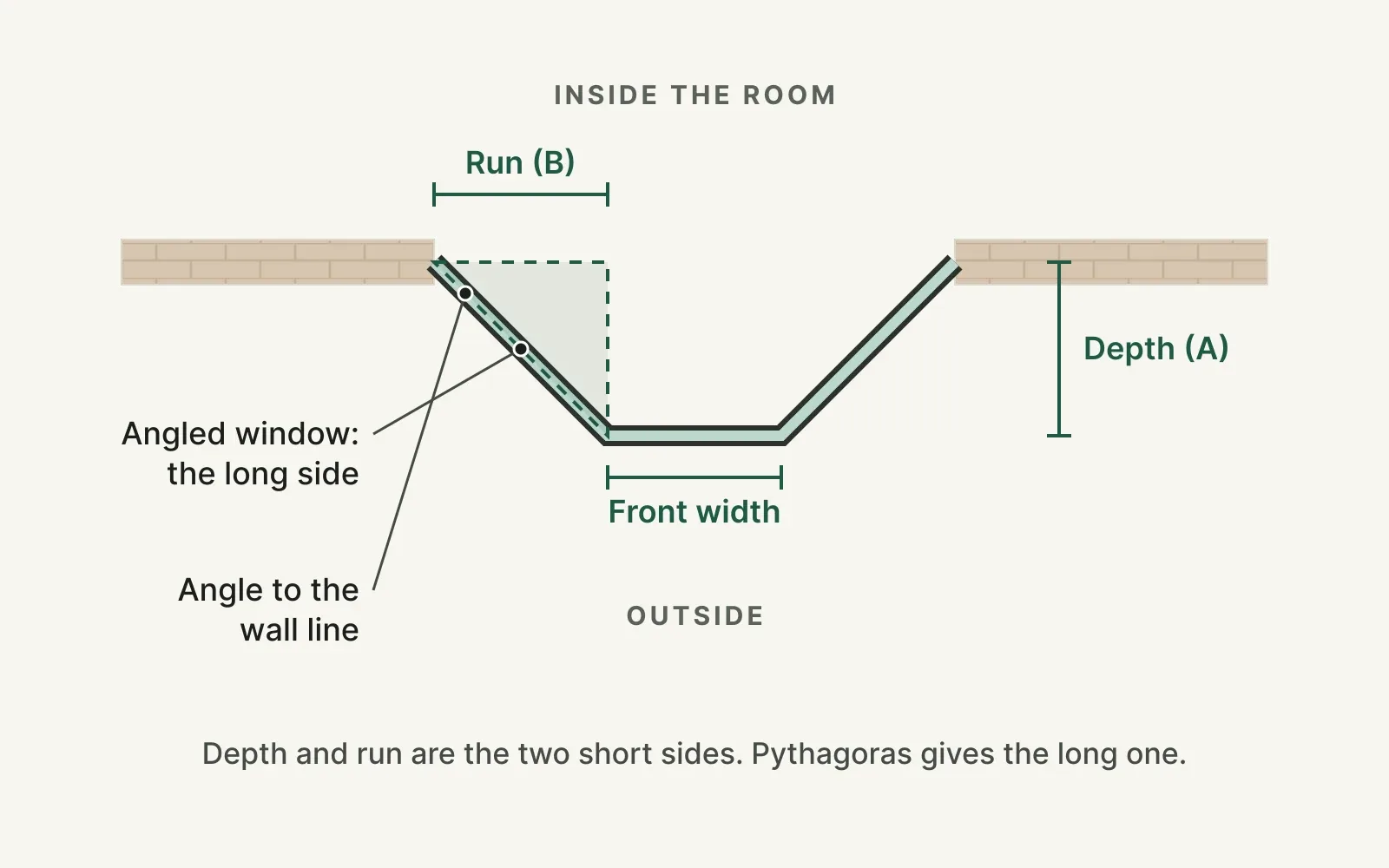
By hand, the steps are:
- Multiply the depth by itself.
- Multiply the run by itself.
- Add the two answers together.
- Take the square root of the total, and that is the width of the angled window.
The old 3-4-5 rule shows it. A depth of 3 and a run of 4 give 9 plus 16, which is 25, and the square root of 25 is 5. The calculator adds the angle, which comes from the ratio of the depth to the run. When the depth equals the run, the side sits at an angle that makes the corner of a 135 degree bay.
The same sum works for other shapes. It gives the sloping length of a lean-to roof, though you would need to add the overhang and the length that runs into the gutter.
Using the bay window calculator on a survey
A fitter measures every width from inside the bay, and the measurements have to be accurate to about a millimetre. They break the bay into separate right-angled triangles, then check that each one works out. If the rectangles come out square and the triangles prove, the bay can be ordered with some confidence.
That matters most when the old bay is twisted or its symmetry is doubtful. Measuring each triangle on its own shows up the part that is out.
In the calculator, enter the measured width of the angled window as well, and it tells you whether your tape and the calculation agree. The calculator treats a gap of more than two millimetres as a reason to measure again, because each measurement is meant to be accurate to within a millimetre.
What the bay window calculator won’t tell you
The calculator checks a survey. It isn’t a substitute for one. The old guidance on this subject was clear that it is an advanced technique for experienced surveyors and not for the handy person, and I agree. The figure you get is the geometry of the opening. It doesn’t give the frame sizes to order, because the manufacturer asks for its own allowances to be taken off. It also says nothing about the structure above the bay or the roof.
What to ask a fitter about a bay
Before you agree a price for a bay, ask:
- Will you survey it from inside, and to within a millimetre?
- Will you check each angled side as a separate triangle?
- Who deals with the structure and the roof over the bay?
- Who certifies the work?
A bay is a bigger job than a straight swap, and it is quoted on top of the price for a single replacement window. For what bay windows cost, see doubleglazing.com’s bay windows guide. If your bay has fixed panes made to look like openers, our guide to dummy sash windows explains them. Put any quote through our quote checker, and see windows explained for how the rest of a window goes together.
VELUX is a trade mark of its owner. The Window Man is independent and is not affiliated with, sponsored or endorsed by any manufacturer. We name brands only to help you compare like with like; see how we make money.
Get quotes for your home
A guide price only takes you so far. Local firms can price the work on your own home, and comparing a few quotes is the quickest way to see what is reasonable.
Compare free quotes