Windows explained
Brewster's fringes in double glazing

Brewster’s fringes are faint grey or coloured bands you sometimes see in a double glazed unit, and they are caused by light, not by a failed seal. The unit hasn’t misted, leaked or cracked. It is an optical effect, and it can appear on perfectly good glass.
What Brewster’s fringes look like
The fringes are an oily-looking effect, small in area, seen from a particular angle. Pilkington’s technical bulletin on interference fringes in insulating glass describes them as faint, irregular, roughly parallel lines, grey or coloured, and says they have little colour or are simply grey. They are less easy to see than other kinds, and they often need special lighting and a particular viewing angle.
Most people never see them. Your eyes are focused on the brighter view outside, which masks the fringes. To see them you have to look at the glass and not through it, which is an unnatural thing to do. If you press the glass lightly, or tap it, the fringes move.
Why Brewster’s fringes happen
Light reflects from the surfaces of the glass. Pilkington explains that a light wave can split at a surface into two new waves, which travel slightly different distances and then combine again. When they are out of step, they cancel each other, and the result is a dim band. When they are in step, the light is stronger.
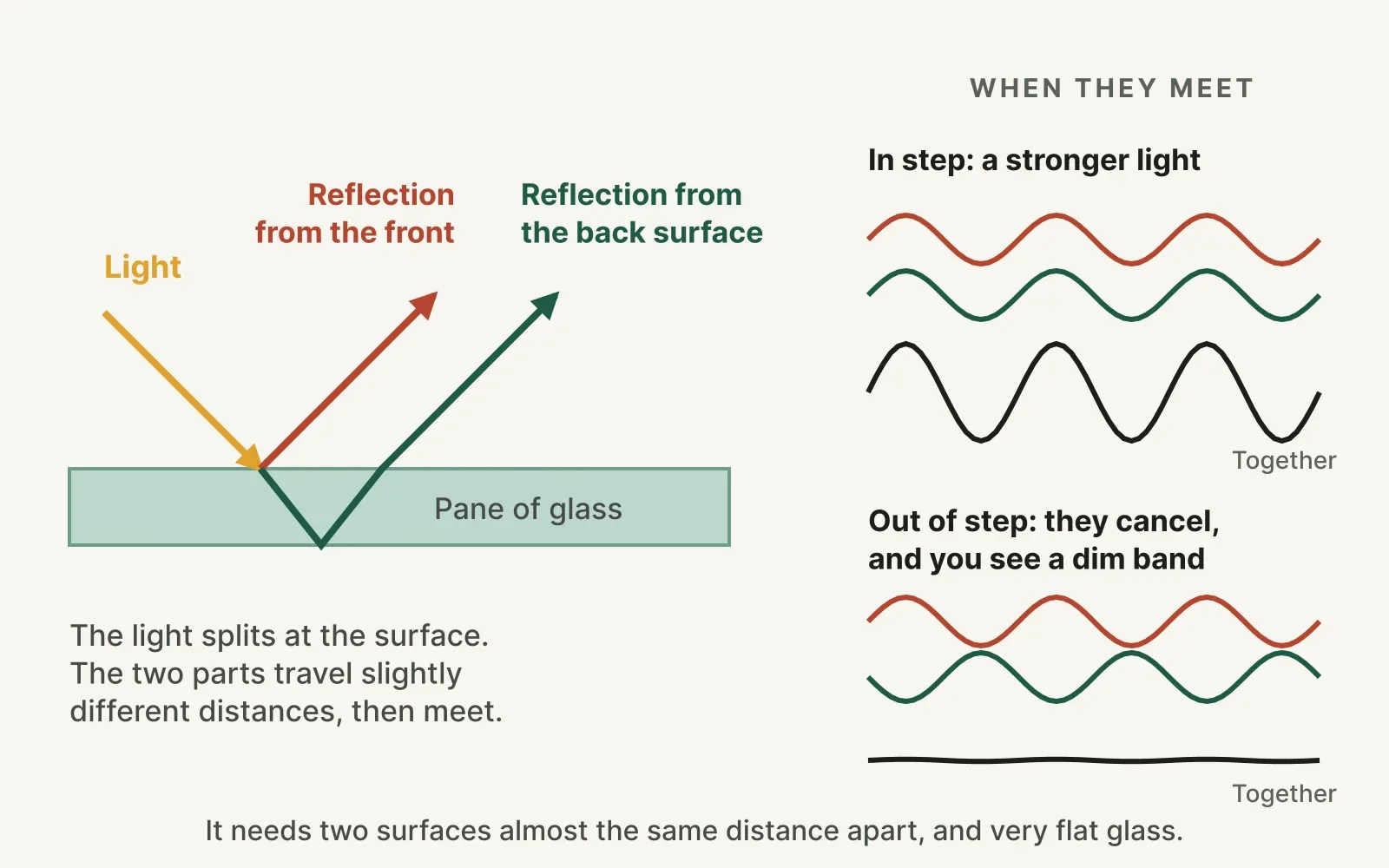
Brewster’s fringes usually need two panes of almost identical thickness, so that the reflections line up, although Pilkington says they can very rarely appear with different thicknesses. They also need glass that is very flat. Pilkington says they are seen because today’s float glass is so flat and free of distortion that the effect can be observed. In my view that makes them a sign of good glass, not bad.
The effect is rather like seeing your own reflection in a window or door when you expected to see through it. Nobody would call that a defect in the glass.
Brewster’s fringes or a fault
Three things can look similar, and they are very different:
- Newton’s rings are coloured rings that appear when the two panes touch in the middle. Pilkington says tapping the glass usually has no effect on them, and that it gives a dull sound with no ringing. They can result from the unit maker failing to control the pressure inside the unit when it was sealed, so they are worth reporting to the installer.
- Mist or droplets between the panes mean the seal has failed. See our guides to sealed units in wooden frames and sealed unit replacement.
- Cracks and stress lines are a different problem again, covered in exploding double glazing.
Can you get rid of Brewster’s fringes
Pilkington says there is no cure. They can often be reduced by making the unit with panes of two slightly different thicknesses. That is a question for the manufacturer when a unit is made, so if you are replacing a unit and the fringes bother you, ask whether it can be built that way.
In patterned or obscured glass, the effect doesn’t occur, because the glass diffuses the light. That is my own observation, and I haven’t found it stated by a manufacturer.
What to do if you see them
- Press the glass gently. If the pattern shifts, it is probably Brewster’s fringes.
- Look for the signs of the faults above: mist, rings that don’t move, or a dull sound when you tap.
- If it is the fringes, you don’t need to replace the unit, and there is nothing wrong with it.
- If it is anything else, tell the installer and check your guarantee.
Put any quote for a replacement unit through our quote checker, and see windows explained for the other ways a sealed unit can look or fail.
VELUX is a trade mark of its owner. The Window Man is independent and is not affiliated with, sponsored or endorsed by any manufacturer. We name brands only to help you compare like with like; see how we make money.
Get quotes for your home
A guide price only takes you so far. Local firms can price the work on your own home, and comparing a few quotes is the quickest way to see what is reasonable.
Compare free quotes